

The Rise of the Managed Intelligence Partner: Unlocking Business Value Through AI, Automation, and Insight
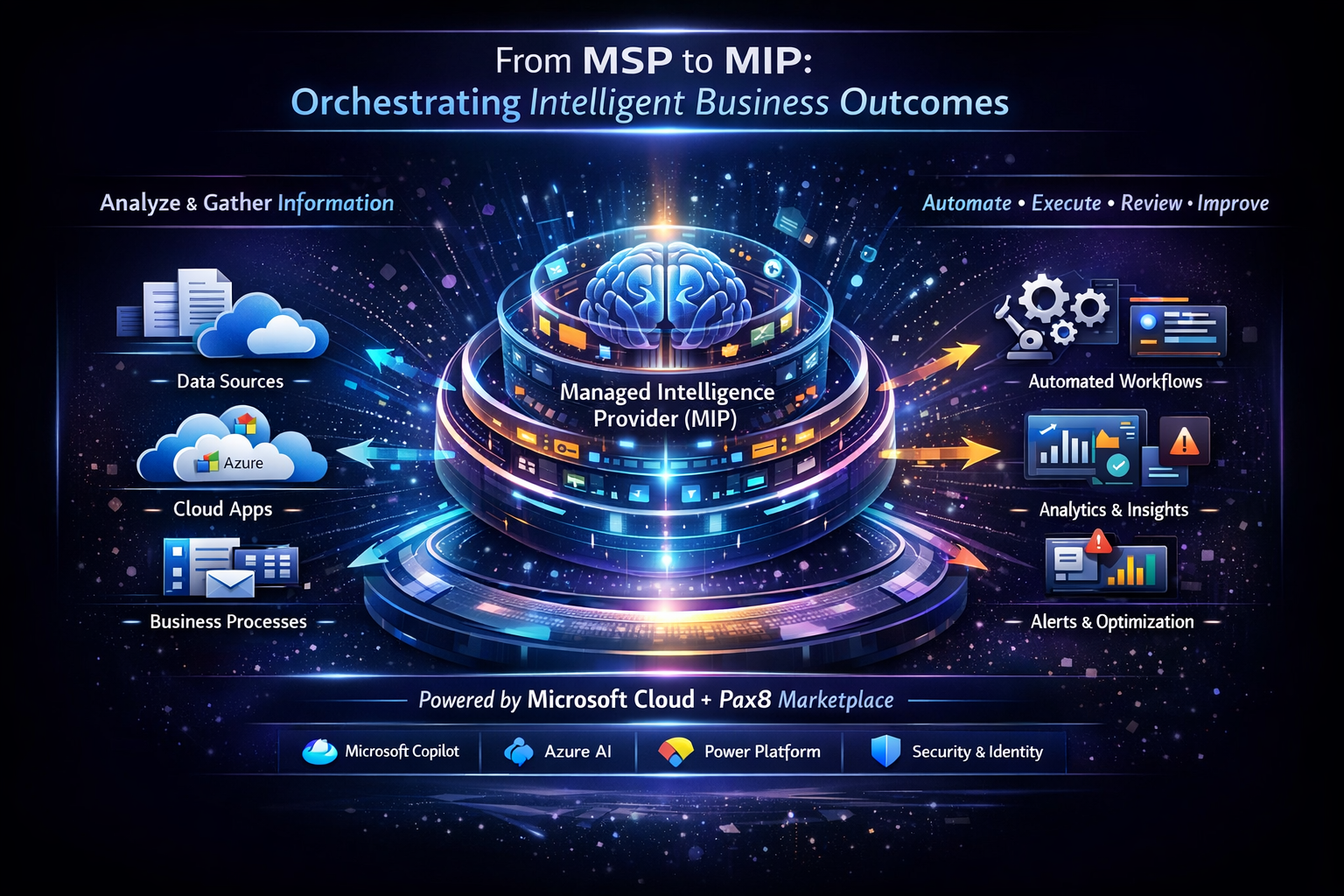
As organizations race to operationalize AI and automation, a new category of partner is emerging—one that goes beyond traditional IT services and into orchestrating intelligence itself. This evolution has accelerated a collaboration between Dynamic Software Solutions with Microsoft giving rise to the Managed Intelligence Partner (MIP).
Unlike legacy managed service providers (MSPs), MIPs are designed to help organizations not just manage technology—but leverage intelligence as a core business asset.
From Managed Services to Managed Intelligence
Traditional MSPs focused on infrastructure: uptime, patching, support tickets, and system maintenance. While essential, this model is increasingly insufficient in an era defined by AI and autonomous systems.
MIPs represent the next evolution. They deploy, manage, and optimize intelligent systems — including AI agents that can reason, act, and adapt in real time.
Through initiatives like our Managed Intelligence Toolkit—built on Microsoft technologies such as Copilot, Azure AI, and agent frameworks—partners can now orchestrate automation and intelligence at scale.
Core Benefits of a Managed Intelligence Partner
1. Intelligent Data Gathering and Contextual Awareness
MIPs transform how organizations collect and use data. Instead of static dashboards, they deploy AI agents that:
- Continuously gather data across systems
- Interpret context in real time
- Surface insights proactively
This shifts businesses from reactive reporting to continuous intelligence, where decisions are informed by live, contextual data streams.
2. Automated Workflows and Digital Labor
One of the most powerful capabilities of a MIP is the ability to implement agentic automation —AI-driven workflows that execute tasks independently.
These systems can:
- Trigger actions across applications
- Coordinate multi-step processes
- Adapt workflows based on outcomes
The result is the emergence of “digital labor,” where software agents take on operational tasks, freeing human teams to focus on strategy and innovation.
3. End-to-End Orchestration Across the Technology Stack
Through our integration processes with Microsoft, MIPs can orchestrate services directly across marketplaces, cloud platforms, and AI systems.
This enables:
- Seamless procurement and deployment of solutions
- Unified management of cloud, security, and AI tools
- Real-time coordination between systems and agents
In effect, the MIP becomes the control layer for the modern digital enterprise.
4. Continuous Analysis and Optimization
MIPs don’t just deploy solutions—they continuously refine them.
Using AI-driven monitoring and feedback loops, they:
- Analyze performance and outcomes
- Identify inefficiencies or risks
- Automatically optimize workflows and configurations
This creates a self-improving operational model, where systems evolve alongside the business.
5. Strategic Advisory and Business Outcome Alignment
Perhaps the most important shift is in the role of the partner.
MIPs move from IT vendors to strategic advisors, aligning technology with measurable business outcomes such as:
- Revenue growth
- Cost reduction
- Operational efficiency
- Risk mitigation
Why This Matters Now
The convergence of AI, cloud marketplaces, and automation platforms is creating solutions where autonomous systems actively participate in business operations.
Through our partnership with you, we can enable:
- Direct integration between AI agents
- Real-time orchestration of services
- Scalable deployment of intelligent solutions
This infrastructure allows businesses of all sizes—not just enterprises—to compete with AI-powered capabilities that were previously out of reach.
The Competitive Advantage of MIPs
Organizations that enlist the services of a Managed Intelligence Partner gain:
- Speed: Faster execution through automation
- Scale: Ability to handle more complexity with fewer resources
- Insight: Real-time, AI-driven decision support
- Agility: Systems that adapt dynamically to change
- Monitoring: Real-time assessment of risk on behalf of clients
- Accountability: auditing and visibility, full audit trails of permissions, interaction with sensitive data (and who accessed it), communications, logs, etc. after incidents
Meanwhile, those relying solely on traditional IT support risk falling behind as intelligence —not infrastructure—becomes the primary driver of value.
Conclusion
The shift from managing systems to managing intelligence marks one of the most significant transformations in modern business.
A Managed Intelligence Partner doesn’t just keep your technology running—they ensure your organization is continuously learning, adapting, and optimizing.
As the Microsoft ecosystem continues to evolve, MIPs will play a central role in helping businesses harness AI—not as a tool, but as a core operational capability.
Contact Us
Contact Dynamic Software Solutions so that we can help begin your journey into the next evolution into a more feasible, secure and profitable way to engage in business.